Triggered Double Exposure Mode
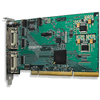
The PIXCI® D2X, CL1 and CL2 Imaging Boards support video rate capture in continuous mode, single trigger mode, or the triggered double exposure mode available in selected digital cameras. In all modes, images are captured with true pixel accuracy, neither compressed nor approximated, allowing precise analysis of particle position or velocity.
The video resolution can be reduced via windowing, capturing a partial field of view at full accuracy, allowing more images to be captured in a given amount of PC memory. Or, images can be captured at slower than video rate, for time lapse sequence capture.
Under Windows 2000 or XP, most of the PC's memory, up to 4 gigabytes excepting 256 or 512 megabytes for the operating system and other applications, can be typically earmarked for image sequences.
For Particle Imaging Velocimetry (PIV) applications, the cameras' triggered double exposure mode allows capture of two images in rapid succession, with an interval between the two image exposures as small as a few microseconds! The camera doesn't transfer the images to the PIXCI® Imaging Board at that speed. Rather the camera's CCD sensor buffers the two images and transfers the image data to the camera and then to the PIXCI Imaging Board at the same rate as in continous mode. Thus, triggered double exposure mode can be used to quickly expose and acquire a pair of images, but the camera can't acquire three or more exposures microseconds apart.
Each camera provides different triggered double exposure mode parameters: the minimum and maximum interval between exposures, and the minimum and maximum duration of the first and second exposures, which are typically different.
A single command to the PIXCI® D2X, CL1, or CL2 Imaging Board captures the two images into two successive frame buffers; the user need not worry about having to issue two commands just microseconds apart.
After capture, the images can be analyzed by the XCAP Interactive Software, which automatically finds and tracks particles across the image sequence. The tracking parameters can be adjusted to include only particles of a specified mass (area) or a specified velocity. After analysis, the particle tracks are reported numerically to screen, file, and/or clipboard, as well as shown overlaid on the image for convenient visualization.