
Tech Tip: Precision Sequence Capture with PIXCI® SV3
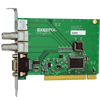
| The PIXCI® SV3 imaging board can capture sequences
of precision images, at video rate, both fields, directly into
PC memory. For RS-170, NTSC, or NTSC S-VIDEO, images are captured
at 752x480 resolution and 30 frames per second. For CCIR, PAL,
or PAL S-VIDEO, images are captured at 920x580 resolution and
25 frames per second. A sequence of images, at video rate, can
be captured until all available PC memory is filled.
Each image in the sequence is captured with precise pixel accuracy, neither compressed nor approximated, allowing detailed analysis of edge position or velocity. Of course the video resolution can be reduced, either via resizing (allowing capture of the full field of view at reduced accuracy) or via windowing (allowing capture of a partial field of view at full accuracy), allowing more images to be captured in a given amount of PC memory. Or, images can be captured at slower than video rate, allowing a longer sampling interval. Under Win 95, most of the PC's memory, excepting 8 or 12 megabytes, can be typically earmarked for images. Under Win NT, most of the PC's memory, excepting 16 or 20 megabytes, can be typically earmarked for images. Under DOS, the ready-to-run XCIP is limited to using 64 megabytes of memory, of which 56 or 60 megabytes can be typically reserved for images. Programs created for DOS, using the XCOBJ "C" library, are constrained only by the version of the DOS extender selected. The table shows the amount of PC memory required to capture full frames, at video rate. Because of precommitted memory usage, the actual amount of memory required may increase slightly, but never more than one additional megabyte.
|
|
||||||||||||||||||